

The Post
Graphic and editorial design of a collectible book
The Post
Sector
Institutional & Administration
Expertises
Sub-expertises
- Editorial Identity
- Graphic identity
Team
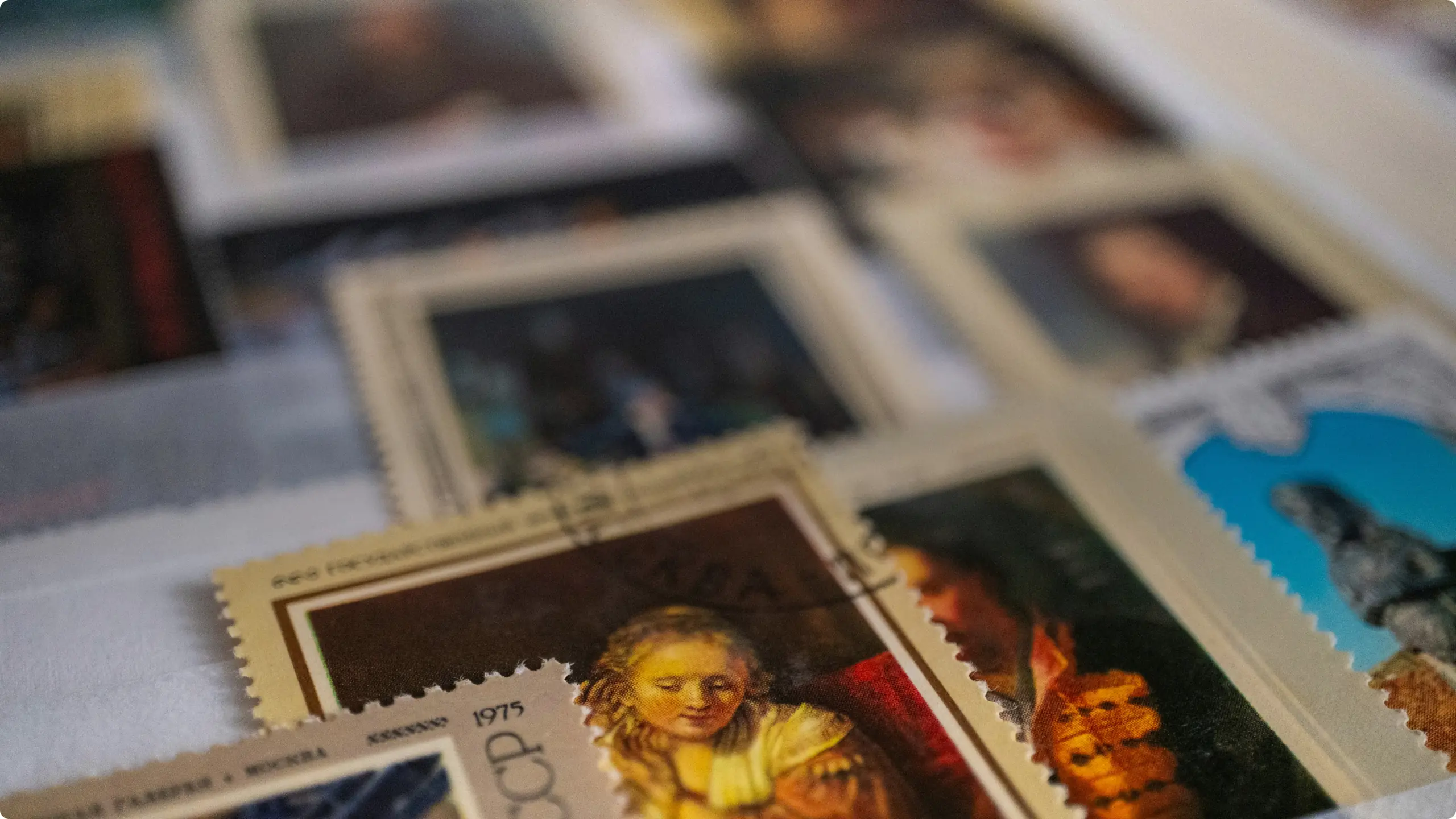
Since 1994, the La Poste Group has published an annual Stamp Book: a collector's item that brings together all the stamps from the philatelic program, sold in several thousand copies. In 2026, the group is launching a consultation to rethink the editorial and graphic design of this work, while respecting a format that has remained unchanged for thirty years, ensuring the coherence of the collection.
148 Collective Agency responds to this consultation with a simple conviction: the stamp is already, in itself, a completed editorial object, and the book should prolong its intensity rather than dilute it. Our proposal explores three distinct graphic choices, a summary conceived as a network rather than a list, and objects that place the postal gesture at the center of the book.
Three ways to make the stamp and the page interact
Our first graphic proposal is based on the very structure of the stamp to make it the generating principle of the entire layout: the frame, the white space, the precision of the alignments become the constitutive elements of the book, carried by the typographic duo Gando and Molitor, between the heritage of the 19th century and Art Deco modernity.
The second focuses on a more intimate dimension of the stamp: the gesture it conveys, to write, to post, to send, to receive. The Immortel typography, both handwritten and mechanical, and a printed text in direct violet-indigo tone compose an editorial landscape where each page carries the memory of an exchange.
The third concentrates on the materiality of the stamp as a produced and reproduced object. A mechanical type typography, principles of repetition and series, a hot stamping on the cover: the book fully embraces its nature as a manufactured object.
Frame, Trace, Impression: three graphic axes coherent with the history of the stamp, for a book that reads like an adventure novel.
A summary designed as a network
Our editorial proposal articulates narrative, image, and information on each double page, with a new module that invites readers to examine the stamp rather than just displaying it. We have also chosen to reorganize the summary into four thematic chapters instead of following the order of the philatelic program, with cross-references between topics that resonate with each other. This way, readers can start with a subject that attracts them and be guided toward others, rather than going through the book in a linear fashion.
Objects that modernize the postal gesture
For the gift inserted in the book, we proposed two ideas that each activate a pillar of the mail. An origami letter-envelope, to be folded by oneself, brings back to the forefront the act of writing and sending. A postcard already addressed to an association that helps isolated individuals transforms the purchase of the book into an act of social connection, with no effort or cost for the sender.
We also designed a special notebook, "My First Stamp Collector's Notebook," conceived as a means of transmission between an adult collector and a child: where to start a collection, how to organize it, which remarkable stamps to observe more closely. A passion-triggering object, apart from the book, that the child can make their own.
If this proposal was not selected at the end of the consultation, it remains one of the ones we are most proud of: it mobilized a strong team around the same editorial requirement, and demonstrated the ability of 148 to carry out a heritage publishing project from start to finish, from the graphic axis to the production specification.


Contact us
With us, your project will become a reality!
The Collective Agency brings together numerous talents who can respond to strategic and/or operational communication projects, targeted or multichannel, short and long term. Do not hesitate to make an appointment with us to discuss and receive a quote for your project!